
A data strategy built around the decisions your business needs
When teams disagree about a report, the problem may begin long before the dashboard. Customer records may be duplicated, systems may use different definitions and nobody may own the information exchanged between them.
DSV Consulting helps Australian organisations define a practical data and integration strategy. We connect business decisions with source ownership, quality requirements, architecture options and the work needed to make information dependable.
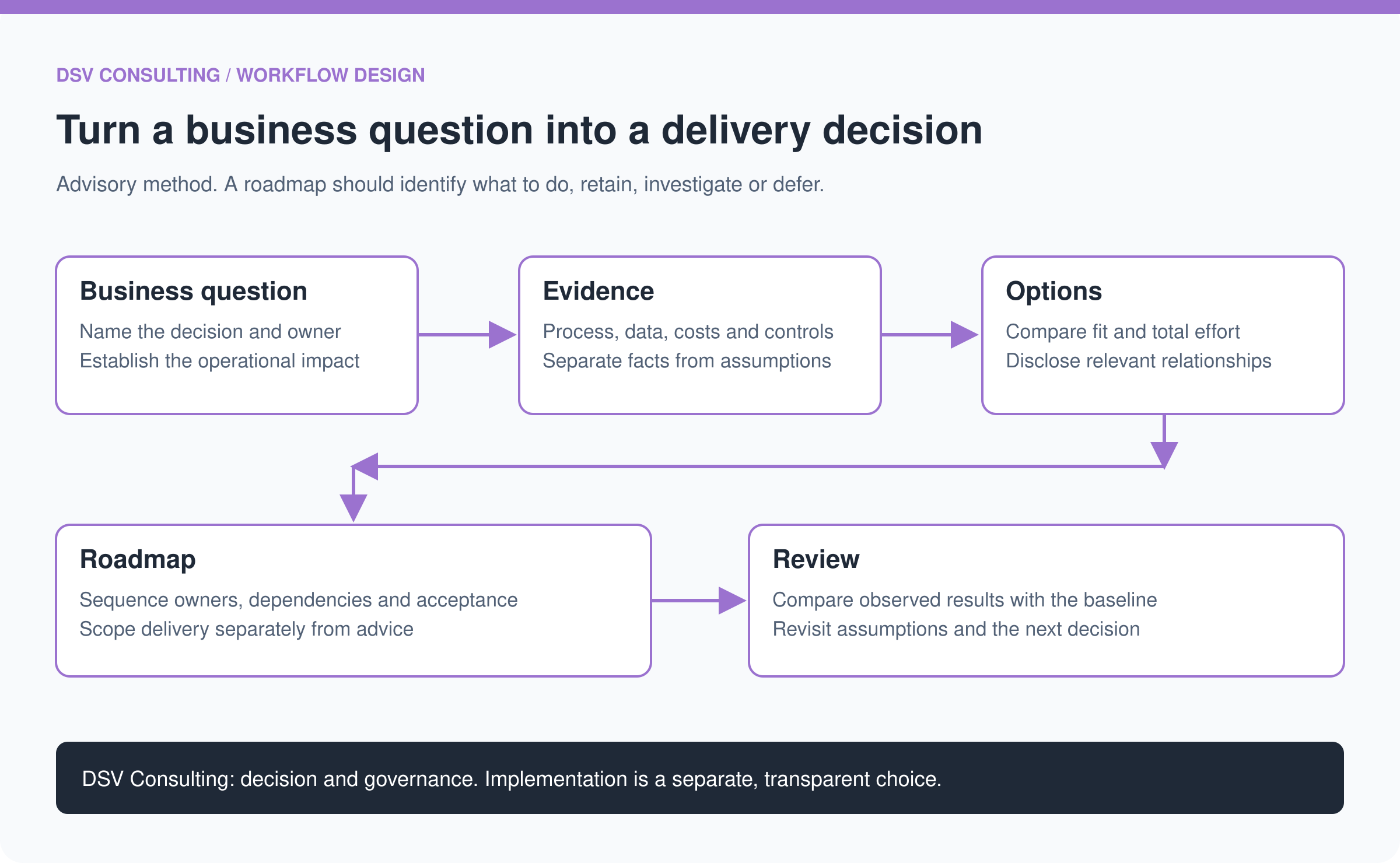
Start with the information that matters
Identify the decisions that rely on data and the consequences when it is late, incomplete or inconsistent. A customer-service team may need current case context, while management may need a reconciled view across business units. Those needs are related but do not necessarily require the same architecture.
We establish the required detail, freshness and access with the relevant owners. This gives the strategy a business purpose and helps avoid selecting a platform before the organisation has defined what it must support.
Map the sources and responsibilities
Record the systems, files and providers that create or hold the relevant information. Identify which source is authoritative for each important entity or measure. Where ownership is unclear, make the decision explicit instead of leaving integration logic to resolve a business disagreement by accident.
The map should show where records are created, changed and corrected. It should also identify the people who can approve definitions and resolve quality issues. Data governance becomes useful when it supports these practical decisions.
What the strategy can include
Business definitions and quality requirements
Agree a shared meaning for important measures and records. Define completeness, validity and reconciliation expectations where they matter. Distinguish issues that can be corrected in a pipeline from problems that need a change in the source process.
Integration priorities
Identify the handoffs that create repeated work or unreliable visibility. Review available interfaces, supplier constraints and operational dependencies. Prioritise integrations by the business outcome they support and the evidence needed to approve them.
Architecture options
Compare reporting integration, warehouse, lakehouse or other appropriate patterns against the requirements. Consider the skills, costs and controls needed to operate them. A more extensive platform is justified only where it serves a material need.
Ownership and operating model
Define who manages sources, transformation rules, quality exceptions and access. Establish how changes to one system are assessed for their impact elsewhere. ## Make AI readiness a specific question
AI initiatives can expose weaknesses in source quality and permissions. Assess the information required for the proposed task rather than label the entire organisation ready or unready. A controlled knowledge use case may need a different foundation from a cross-system agent with permission to act.
The strategy should identify authoritative sources, access boundaries, freshness and evaluation needs for each relevant use. It should not assume that moving data into a new platform makes every downstream AI application appropriate or reliable.
Turn architecture into a delivery sequence
Separate foundational decisions from implementation tasks. An agreed customer identifier may need to precede consolidation. A reporting definition may need approval before a dashboard is built. A supplier's interface limitations may determine whether a proposed integration is feasible.
The roadmap should show these dependencies, owners and acceptance criteria. Investigate uncertain technical assumptions before committing to the wider build.
Use group delivery experience transparently
The group has confirmed experience in daily ETL work for Motilal Oswal through Fristine Infotech and in Databricks dashboards for an anonymous wealth-management organisation. These examples inform implementation questions but are not presented as Australian DSV Consulting client outcomes.
DSV Consulting's role in this service is advisory. Any engineering work through FI Digital, Fristine or another provider should be separately scoped, with relevant relationships disclosed and the client's delivery choice made explicit.
Know what the review will answer
The output can include a source and ownership map, quality findings, business definitions, integration priorities, architecture options and a phased roadmap. The scope determines the level of technical detail. It should identify the next decisions and investigations rather than imply that detailed engineering is already complete.
Frequently asked questions
Is a data strategy the same as buying a data platform?
No. The strategy establishes what information the business needs, who owns it and how it should be governed and connected. A platform may support that design, but it does not resolve definitions or responsibilities by itself. We compare architecture options after the requirements and operating constraints are understood within the agreed scope.
Can you help when departments report different numbers?
Yes. We can trace the definitions, sources, periods and transformations behind a representative measure. Differences may arise from duplicates, timing, exclusions or corrections. The review identifies the decisions and changes needed to establish a trusted definition. Redesigning the chart alone will not resolve a disagreement rooted in the underlying data or process.
Do you provide engineering as part of this service?
This page describes advisory work. Detailed implementation can be scoped separately with an internal team, another provider or a group delivery business. The strategy should specify requirements, dependencies and acceptance measures that support that choice. Relevant relationships are disclosed so advisory conclusions and subsequent delivery proposals can be evaluated separately.
Will you recommend Databricks for every engagement?
No. Databricks is one possible technology, and its suitability depends on the requirements, existing environment and operating capability. Other approaches may be sufficient or more appropriate. The group's delivery experience does not establish an official partner status. A recommendation should explain the fit and trade-offs rather than rely on a platform name.
How do you prioritise integrations?
Consider the business outcome, frequency of the problem, quality of available information and consequences of failure. Also assess source-system constraints and dependencies. An integration should have a clear owner and acceptance criteria. The most technically interesting connection is not necessarily the one that will remove the most important operational obstacle first.
Can we prepare for AI without rebuilding everything?
Potentially. Start with the information required by a specific use case and assess its quality, permissions and freshness. A bounded application may need a focused preparation effort. Wider use may justify broader foundations. The strategy should distinguish those needs rather than make an organisation-wide platform rebuild a prerequisite for every AI initiative.
Who should participate in the review?
Include the business owners who use the information, technology owners who manage the systems and people responsible for data quality or reporting. Finance, privacy or security specialists may also be needed. The sponsor should have a route to resolve definition and ownership decisions. We agree participation requirements so the output can be acted upon.
How do you measure whether the strategy was useful?
Assess whether it resolves important decisions and produces a deliverable sequence with owners, dependencies and acceptance measures. Later implementation can be evaluated through relevant outcomes such as reconciled reporting or fewer manual corrections. The advisory document itself is not proof of a business improvement; value depends on the decisions and work it enables.
Bring the report or handoff you cannot trust
Describe the decision, the sources and the disagreement or manual work involved. We can define a focused review and determine whether the issue requires a process correction, an integration or a broader data architecture change.
Discuss your data and integration roadmap